Evaluating the Column Subtraction with Decimals Game for Practical Math Fluency
Mastering decimal subtraction remains a persistent hurdle in upper elementary mathematics, often due to misalignment of place values or confusion regarding borrowing across the decimal point. The Column Subtraction with Decimals Game addresses this specific pedagogical gap by converting repetitive drill work into a structured board game format. For educators, homeschoolers, and parents seeking tangible resources to reinforce numerical fluency, this tool offers a low-tech, high-engagement alternative to digital apps or standard worksheets. Its primary value lies in its ability to facilitate deliberate practice within a social framework, allowing students to internalize algorithms without the psychological friction typically associated with remedial math sessions.
Mechanics and Instructional Design
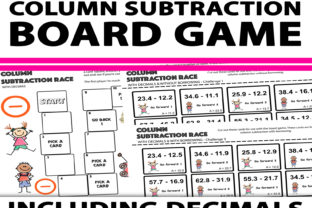
The game is designed for 2–4 players, making it suitable for small group instruction, learning centers, or family practice time. The core mechanic relies on a linear progression system where players roll dice to advance along a board. Movement is contingent upon correctly solving subtraction problems encountered on specific squares. This immediate feedback loop is critical; unlike a worksheet where errors may go unnoticed until grading, the game environment provides instant verification through peer review or answer keys.
From an instructional design perspective, the inclusion of two distinct card sets demonstrates an understanding of scaffolded learning. The pack contains:
- Playing cards with decimals without carrying: These allow learners to focus exclusively on vertical alignment and place value concepts without cognitive overload.
- Playing cards with decimals with carrying: Once the basic structure is mastered, these cards introduce the complexity of regrouping across the decimal point.
- Times table cards (2–10): While seemingly tangential, these serve as a supplementary reinforcement tool, acknowledging that multiplication fluency often supports broader numerical confidence.
This separation of skills allows facilitators to differentiate instruction effectively. A mixed-ability group can utilize different decks simultaneously, ensuring that advanced learners remain challenged while those requiring foundational support are not overwhelmed. The physical components—board, cards, counters, and dice—are standard, meaning replacement parts are easily sourced if lost, which enhances the product's long-term usability in busy classroom environments.
Practical Application in Learning Environments
In real-world application, the Column Subtraction with Decimals Game functions best as a consolidation activity rather than an initial teaching tool. Students should already possess a conceptual understanding of decimals before engaging with this game. Its strength is in automating the procedural aspect of subtraction. When evaluating its effectiveness, consider the following operational factors:
Cognitive Load Management
Traditional drills often induce fatigue because they lack context. By embedding problems within a game narrative, the cognitive load shifts from "enduring a test" to "achieving a goal." Observations suggest that students sustain attention longer during gameplay, resulting in a higher volume of problems solved per session compared to independent desk work. However, facilitators must monitor the pace to ensure speed does not supersede accuracy. The competitive element can sometimes encourage guessing; establishing a rule that requires showing working out on paper or whiteboards can mitigate this risk and maintain academic rigor.
Differentiation and Flexibility
The dual-card system is the product’s most significant asset for diverse classrooms. Educators can pre-sort decks based on formative assessment data. For example, a student struggling with tenths and hundredths alignment can work exclusively with non-carrying cards, while a peer ready for extension tasks tackles carrying scenarios. This flexibility extends to home use, where parents can adjust difficulty based on their child’s current curriculum stage without needing to purchase additional materials.
Durability and Presentation
As a physical resource, longevity depends on initial preparation. Cards and boards intended for frequent classroom rotation benefit significantly from lamination or protective sleeving. The visual presentation is functional rather than decorative, prioritizing clarity of numbers over thematic artwork. This professional aesthetic helps older students avoid feeling patronized, a common issue with math games that appear too juvenile for upper primary or middle school intervention groups.
Strengths and Limitations
An objective evaluation requires acknowledging both the utility and the boundaries of this resource. Understanding these parameters helps buyers determine if the Column Subtraction with Decimals Game aligns with their specific objectives.
Key Strengths
- Targeted Skill Isolation: Unlike generic math games that mix operations, this resource focuses specifically on column subtraction with decimals, allowing for intensive remediation.
- Social Learning Component: Peer interaction encourages verbalization of mathematical thinking. Students often explain strategies to one another, reinforcing their own understanding through articulation.
- Low Barrier to Entry: No technology, batteries, or internet connection is required. Setup is instantaneous, maximizing actual learning time during short intervention windows.
- Cost-Efficiency: Compared to subscription-based digital platforms or comprehensive curriculum kits, this single-purpose game offers high value for targeted skill building.
Potential Limitations
- Narrow Scope: This is not a comprehensive decimal unit. It does not cover addition, multiplication, division, or conceptual modeling of decimals. It must be paired with broader instructional materials.
- Dependency on Dice Luck: In some iterations of board games, excessive luck can frustrate competent students who solve problems correctly but roll poorly. Facilitators may need to implement house rules (e.g., correct answers grant extra movement) to balance skill and chance.
- Preparation Time: If purchased as a printable or uncut set, significant upfront time is required for cutting, sorting, and laminating. Buyers should factor this labor cost into their decision-making process.
- Assessment Gaps: Gameplay provides observational data but not necessarily recordable metrics. Teachers wishing to track progress over time will need to create separate tracking sheets or observation checklists.
Audience Fit and Strategic Recommendations
Determining whether this resource warrants investment depends on the user’s role and current needs. The Column Subtraction with Decimals Game is particularly well-suited for specific segments of the education and parenting community.
Classroom Teachers and Special Education Professionals: This game is ideal for math stations or RTI (Response to Intervention) blocks. It serves as an excellent independent activity that keeps students productively engaged while the teacher works with a focused group. The differentiation potential makes it valuable for inclusive classrooms with wide ability ranges.
Homeschoolers and Tutors: For those managing individualized curricula, this game breaks the monotony of textbook exercises. It provides a tangible way to review skills before moving to new units. The inclusion of times table cards adds peripheral value for multi-age households where younger siblings may participate alongside older students.
Parents Supporting Home Learning: If a child exhibits anxiety around decimal homework, this game can reset the emotional tone of practice sessions. It transforms a solitary struggle into a collaborative family activity. However, parents should view it as a supplement to, not a replacement for, direct instruction on the underlying concepts.
Implementation Best Practices
To maximize return on investment and educational impact, consider these practical recommendations:
- Establish Accountability Protocols: Require players to record calculations on mini-whiteboards or scratch paper. This prevents mental math shortcuts that bypass the intended column method practice and provides evidence of learning.
- Rotate Card Sets Regularly: Prevent stagnation by cycling between carrying and non-carrying decks. As proficiency increases, introduce a mixed deck to build adaptability.
- Integrate Error Analysis: Pause gameplay periodically to discuss common mistakes observed during play. Turning errors into teachable moments leverages the immediate context of the game for deeper understanding.
- Pair with Manipulatives: For students still struggling despite gameplay, keep base-ten blocks or decimal grids accessible at the table. The game should reinforce concrete-to-abstract transitions, not replace them.
Final Assessment of Educational Value
The Column Subtraction with Decimals Game represents a focused, practical solution to a well-defined learning challenge. It avoids the trap of being overly broad or technologically dependent, instead offering a reliable, tactile method for building procedural fluency. While it cannot replace comprehensive instruction or address conceptual misunderstandings on its own, it excels as a reinforcement tool within a balanced mathematics program.
For professionals and caregivers evaluating resources, the decision should hinge on whether decimal subtraction is currently a priority area for development. If the goal is to increase automaticity, reduce calculation errors, and foster a more positive attitude toward decimal operations through structured play, this game delivers measurable utility. Its simplicity is its strength, providing a distraction-free environment where the mathematics remains central to the experience. When implemented thoughtfully with appropriate scaffolding and accountability measures, it transforms routine practice into meaningful skill acquisition, justifying its place in both educational and home learning toolkits.