Retro Pixel Game Icons Set: A Comprehensive Guide to Nostalgic Vector Assets
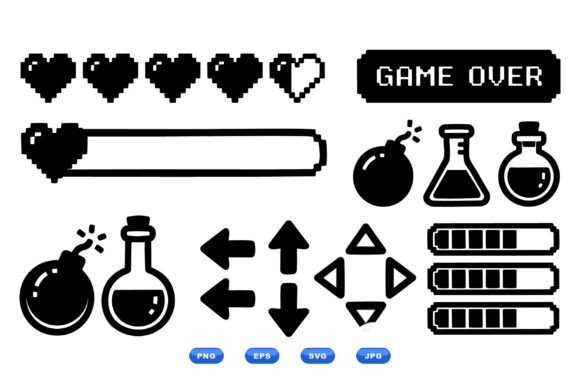
The resurgence of retro aesthetics in modern design is more than a fleeting trend; it is a cultural callback to an era defined by 8-bit creativity and digital simplicity. For designers, crafters, and content creators, capturing this specific nostalgic mood requires assets that are authentic yet versatile. The Retro Pixel Game Icons Set serves as a bridge between vintage gaming culture and contemporary production needs. This collection offers a curated library of monochrome pixel graphics, featuring essential interface elements like hearts for health bars, bombs, potions, directional arrows, and classic game over messages. Understanding how to leverage these assets effectively can elevate projects ranging from apparel design to user interface development.
Deconstructing the Visual Language of Retro UI
To utilize this asset pack successfully, one must first understand the design philosophy behind it. Unlike modern high-definition icons that rely on gradients and shadows, pixel art communicates through restriction. Every square in the grid serves a deliberate purpose. The Retro Pixel Game Icons Set adheres to this discipline, providing artwork that feels native to the golden age of console and arcade gaming.
The inclusion of specific UI elements is not arbitrary. Hearts representing health are universally recognized symbols of vitality in gaming history, transcending language barriers. Bombs and potions introduce concepts of risk and reward, while directional arrows provide intuitive navigation cues without cluttering a layout. The "Game Over" message, rendered in stark monochrome, carries an emotional weight that modern typography often lacks. These elements are not merely decorative; they are functional semiotic tools that instantly convey meaning to an audience conditioned by decades of interactive entertainment.
The Technical Advantage of Vector Formats
A common pitfall when working with retro aesthetics is the issue of resolution. Authentic pixel art is inherently low-resolution, which creates challenges when scaling up for physical products like t-shirts or large-format prints. This listing addresses that limitation directly by providing the artwork in scalable vector formats, including SVG and EPS.
Vectorization transforms raster pixels into mathematical paths. This means you can resize a tiny 16x16 pixel heart to fit a billboard without losing edge definition or introducing blur. For users of cutting machines like Cricut and Silhouette, the SVG format is particularly vital. It allows the machine to read distinct cut lines rather than tracing jagged bitmap edges. The editable PNG files offer transparency for digital layering, while the JPG previews serve as quick references for cataloging your asset library. Having 100 vector artworks in a single instant download ZIP ensures that your workflow remains uninterrupted, whether you are designing a sticker sheet or a complex web interface.
Practical Applications Across Creative Disciplines
The versatility of the Retro Pixel Game Icons Set extends far beyond video game development. Because the design style is monochrome and iconic, these assets integrate seamlessly into various commercial and personal projects.
- Apparel and Merchandise: Streetwear brands frequently utilize pixel art to evoke nostalgia. A simple arrangement of hearts and potions on a chest pocket creates a subtle, recognizable motif that appeals to gaming enthusiasts without being overtly loud.
- Physical Crafting and Stickers: For the maker community, these icons are ideal for vinyl decals, planner stickers, and scrapbooking. The clean lines of the vector files ensure that weeding vinyl is straightforward and that printed stickers have crisp borders.
- Packaging Design: Indie food and beverage brands often use retro gaming tropes to stand out on shelves. A hot sauce bottle featuring pixelated bombs or a energy drink displaying health hearts uses visual shorthand to communicate flavor intensity or revitalization.
- Digital Interfaces and Streaming: Streamers and UI designers can use these assets to create custom overlays, chat badges, or website navigation buttons. The monochrome palette makes it easy to recolor the vectors to match any brand identity while retaining the retro texture.
Evaluating Suitability for Your Project
While this asset pack is comprehensive, it is important to assess whether it aligns with your specific goals. The monochrome nature of the set is its greatest strength but also its primary constraint. If your project requires full-color, multi-shaded pixel art reminiscent of 16-bit or 32-bit eras, this set may serve better as a foundational layer rather than a complete solution. However, for projects prioritizing minimalism, readability, and classic arcade vibes, the uniformity of this collection provides a cohesive visual system that mixed-and-match assets cannot achieve.
Professionals should also consider licensing and modification rights. Since these are editable vectors, you have the freedom to alter shapes, combine elements, or adjust stroke weights. This editability transforms the pack from a static library into a dynamic design toolkit. For example, a designer might modify the standard potion icon to look like a coffee cup for a café menu, maintaining the pixel aesthetic while adapting the context.
Navigating Production Considerations
Working with pixel-style vectors requires specific attention to detail during the production phase. When preparing files for print or cut, ensure that your canvas dimensions respect the grid structure of the original art. Stretching a pixel icon disproportionately can distort the "squareness" that defines the style. Always scale proportionally.
For those using the Retro Pixel Game Icons Set in digital environments, consider the display context. On high-DPI screens, vector SVGs will render perfectly. However, if you are exporting to raster formats for web use, ensure you export at exact integer multiples of the original pixel size (e.g., 2x, 4x, 8x) to prevent anti-aliasing artifacts that make pixel art look muddy. The provided transparent PNGs are likely optimized for this, but creating your own exports from the source EPS files gives you total control over output quality.
The Value of Instant Digital Delivery
In professional and hobbyist workflows alike, time is a critical resource. The instant download ZIP format eliminates shipping delays and allows for immediate integration into ongoing projects. This immediacy supports iterative design processes where testing multiple visual directions is necessary. Having 100 distinct artworks available locally means you can rapidly prototype a shirt design, test a sticker layout, or mock up a packaging concept without waiting for external assets or worrying about internet connectivity.
Furthermore, owning the source vector files provides long-term value. Unlike subscription-based asset libraries where access ceases when payments stop, this purchase grants perpetual ownership. You can archive the EPS and SVG files for future campaigns, ensuring that your brand’s retro visual identity remains consistent across years of production.
Final Thoughts on Retro Asset Integration
The enduring appeal of retro gaming lies in its ability to simplify complex emotions into recognizable symbols. A heart is not just a shape; it is safety. A bomb is not just an explosive; it is urgency. The Retro Pixel Game Icons Set captures this semiotic power in a format that respects modern production standards. By combining the nostalgic authenticity of monochrome pixel art with the technical flexibility of scalable vectors, it empowers creators to produce work that feels both timeless and professionally polished.
Whether you are a business owner seeking unique packaging graphics, a crafter designing personalized gifts, or a developer building a retro-inspired interface, understanding the nuances of these assets is key to success. Focus on the grid, respect the scalability, and leverage the universal language of retro UI. When applied thoughtfully, these icons do more than decorate; they connect with audiences on a visceral level, turning ordinary objects and interfaces into portals to a beloved digital past.